
Newsletter Volume 2 No.1 May-June 2026
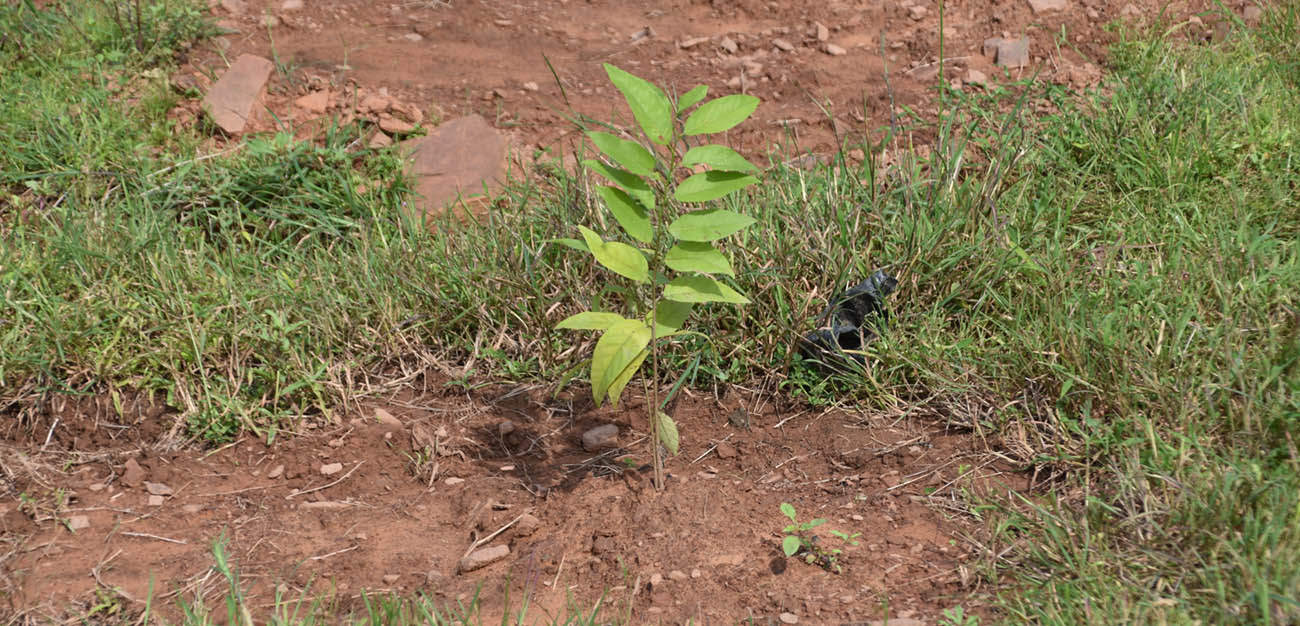
The Hon’ble Supreme Court of India issued a landmark judgment to protect the Great Indian Bustard (GIB) and the Lesser Florican, two of the country’s most endangered bird species, on December 19, 2025. The case highlighted the urgent need to safeguard these grassland species.
The Great Indian Bustard, with fewer than 150 birds left, is more than a species on the brink - it is a litmus test for India’s commitment to its grasslands. Once roaming from Punjab to Tamil Nadu, the GIB today survives mainly in Rajasthan and Gujarat, its decline driven by habitat loss, power-line collisions, and neglect of arid ecosystems. Conserving the GIB matters because its fate is tied to ours. Bustards are umbrella species: protect their grassland-savanna home and we secure watersheds, carbon sinks, and grazing lands that sustain rural livelihoods. Their collapse signals desertification and the death of open landscapes.
India’s Project GIB, captive breeding, and undergrounding of power lines are steps forward, but time is short. Losing the GIB would mean erasing a 11-kg symbol of our natural heritage forever. Saving it demands treating grasslands not as wastelands, but as vital, living infrastructure.
By: Avinash Shrivastava, NCHSE
Under this programme, NCHSE is implementing the project titled” Improving sustainability and productivity of degraded /agro-ecosystems through adoption of Climate smart practices” in Deori Liladhar and Patloni villages under Tendukheda Tehsil of Damoh District of Madhya Pradesh since October 2024. The project area is a hot spot of water scarcity, land degradation, low cropping intensity, poor crop and livestock productivity and socio-economic status. Agriculture is the mainstay of their livelihood, though the landholdings are small and mostly lacking irrigation facility, and thus are deprived of taking multiple cropping in a year. Due to lack of pasture land, there is deficiency of green fodder. In both the villages, 98% households allow their cattle to graze in forest land. The project relies on participatory development approach for the targeted interventions, namely-
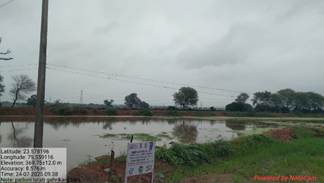
Fig. 1: Tank Deepening work at Patloni village
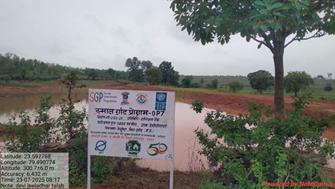
Fig. 2: Irrigation Tank at Deori Leeladhar
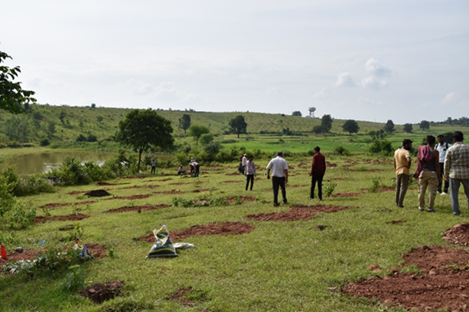 Fig.3 : Eco restoration of common land through plantation
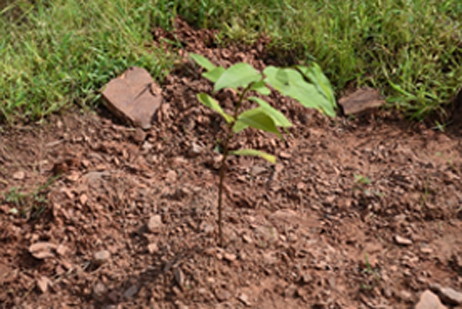 Fig.4 : Eco restoration of common land through plantation
Agriculture is crucial for ensuring food, nutrition and livelihood securities for India. It engages almost two-third of the workforce in gainful employment. On account of its close linkages with other economic sectors, agricultural growth has a multiplier effect on the entire economy of the country. Indian agriculture had made a significant contribution towards achieving food security in the country. Currently, however, it faces many challenges like stagnation of net sown area, plateauing yield level, deterioration of soil quality, reduction in per capita land availability and above all lack of assured irrigation facility. About 60% of the net cultivated area in India is rainfed and exposed to biotic and abiotic stresses arising from climatic variability and climate change, which is likely to aggravate the problem of future food security, which makes the small and marginal farmers (SMFs), having cultivable land of less than one hectare to two hectares, with poor coping capacity especially vulnerable.
Besides improving availability of water for agriculture, new technologies are being evolved to improve water use efficiency, economising consumptive water as well as reducing fertiliser use thereby reducing input cost to farmers and carbon foot print at large. One such technology is the use of bio polymers, like Fasal Amrit. It is a certified organic, 100% biodegradable super absorbent polymer made from fruit and vegetable waste. It absorbs water up to 50 times its weight, retaining moisture for 5-15 days, reducing irrigation by 40%, and minimizing drought effects. It prevents fertilizer leaching, cutting usage by 20% while enhancing soil health. Being fully biodegradable in six months, it proved to an eco-friendly alternative to synthetic products. By improving water use efficiency, reducing costs, and increasing yields, it fosters sustainable and climate-resilient farming.
Field Trial of Fasal Amrit with Wheat crop in rabi season of 2024-25 was undertaken in 255 Acre land, one acre per farmer in 26 villages of Sultanpur, Sangod & Ladpura blocks of Kota district. The result as presented below is quite encouraging.
Conclusion:
The Kota trial successfully demonstrates the effectiveness of organic plymers like Fasal Amrit in reducing fertilizer requirement and water usage while improving soil moisture retention, which translate to both economic benefits and improved environmental sustainability.
As per the Second Advance Estimates of production of Major Agricultural Crops (Kharif & Rabi) for the year 2025-26 released by the Ministry of Agriculture and Farmers Welfare, the Kharif food grain production is estimated at 1741.44 LMT and Rabi food grain production at 1745.13 LMT. The Kharif Rice production is estimated at 1239.28 LMT and that of Rabi Rice at 167.20 LMT. Production of Wheat is estimated at 1202.10 LMT, and that of Sugarcane – 5001.97 LMT. These crops are preferred by farmers since they provide higher economic return, as compared to other crops. However, rice, wheat and sugarcane cropping creates environmental hazard due to on field burning of crop residues left behind after the crop harvest.
According to the Indian Ministry of New and Renewable Energy (MNRE, 2019), India generates on an average 500 Million tons (MT) of crop residue per year. The same report shows that a majority of this crop residue is in fact used as fodder, fuel for other domestic and industrial purposes. However, there is still a surplus of 140 MT out of which 92 MT is burned each year.
The burning of crop residues generates numerous environmental problems, like emission of greenhouse gases (GHGs) that contributes to the global warming, increased levels of particulate matter (PM) and smog that cause health hazards, loss of nutrients (N, P, K, sulphur) and organic carbon, loss of biodiversity of agricultural lands, and the consequent deterioration of soil fertility.

Waste from the agricultural industry can be beneficially utilized in various agro-based applications and other industrial processing. However, the cost of collection, processing and transportation can be much higher than the revenue from the beneficial use of such waste.
The National policy for management of crop residue (NPMCR, 2014) formulated by the Central Government, has laid out policies and regulations to be undertaken by the local agencies to curb crop burning and initiatives towards sustainable management practices.
The most of the government interventions thus far have mainly focused on the energy production out of crop residue, particularly biogas production. Some of the residues are processed to be used in construction applications, such as the use of rice husk ash in cement mixes. Husk and bagasse ash are also being utilized for mushroom cultivation. Other interventions include composting, biochar, and in-situ management through mechanical intensification.
By : Deependra Singh & Brajesh Singh Kirar
NCHSE has taken up initiative for crop residue management as a part of its climate smart agricultural programme supported by the ITC Mission Sunhra kal in Kota district of Rajasthan and Vidisha district of Madhya Pradesh. Programme involve handholding support to farmer’s group through capacity building for project development, leveraging financial support and marketing of the crop residues is a systematic manner. The process also involves preparing bundles of crop residues in the field and transporting them to companies that produce biofuels. In the present case Reliance Ltd procures the bundled crop residue as per an agreement between ITC ltd with Reliance Ltd to provide 10,000 metric tons of crop residue per year.
Objectives:
Scope:
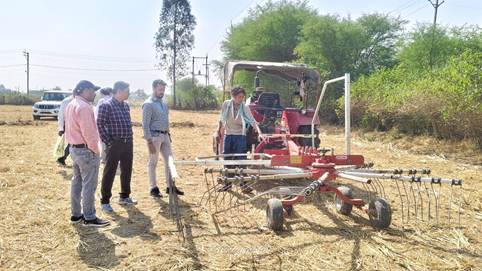
Most of the farmers prefer to sell Paddy straw on their own fields,some farmers store for animal fodder. Local traders buy the straw from farmers at arbitrary rates and sell it to companies like DCM and Chambal. Recently Reliance started Bio CNG plant at CSV (project) villages. Therefore, most of the farmers are willing to adopt new technologies, including baler technique using baler machine for paddy crop residue management and sowing through zerotillage machine.

Out come:
Use of Baler machines, which help in collecting, compressing, and packaging the crop residues into bales for easier storage, transport, and disposal found acceptable by the farmers. During 2024-25, about 50-60 farmers made bundles of residue of about 120-150 acres of their land and sold them to Reliance bio CNG unit.
Entrepreneur Mr. Pramod Gahlot:
Pramod Gahlot, a CSV farmer and a Member of Radhe Radhe Farmer Field School of Village Kheda Rasulpur, purchased baler machine (A farm machinery used for compressing a cut and raked crop into compact bales that are easy to handle, transport, and store) investing around around Rs 22,00,000 and started baler macking at the field of intersted farmers. In the current year he made around 1980 ton of bales from 1090 farmers and sold them to Reliance boi CNG unit @ Rs 200 per qtl. making business of around Rs-3,96,000. He saved around Rs 3,40,000 after meeting expenses on payment to staff, rent for tractors, etc.
Wetlands hold significant cultural and traditional importance in India. Which has made major strides in wetland conservation, boasting the largest network of Ramsar Sites in South Asia, covering 1.33 million hectares. These sites contribute significantly to biodiversity, hosting 6200 species across various faunal groups. India's wetlands serve as crucial stopovers for millions of migratory birds, playing a vital role in maintaining waterbird populations globally. Despite global threats, India is reversing the trend of shrinking wetlands through legal protections and conservation efforts.
On the eve of World Wetlands Day 2026, India added 2 wetlands viz. Patna Bird Sanctuary (Uttar Pradesh) and Chhari-Dhand (Gujarat) as Ramsar sites, raising the national total to 98.
Patna Bird Sanctuary (Uttar Pradesh)
Located in the Jalesar subdivision of Etah district, it spans just over 1 sq km, making it among Uttar Pradesh’s smallest wildlife sanctuaries. The sanctuary includes freshwater marshes, woodlands, and grasslands within an agricultural landscape, supporting diverse habitats. During winter, it hosts tens of thousands of migratory birds such as the Rosy Pelican, Eurasian Spoonbill, and Northern Pintail, underscoring its role on the Central Asian Flyway. It records 178 bird species and 252 plant species, sustains key waterbird populations, and is designated an Important Bird and Biodiversity Area by BirdLife International.
Chhari-Dhand (Gujarat)
It is a seasonal saline wetland between the Banni grasslands and Kutch salt flats, expanding to nearly 80 sq km during the monsoon in the arid Kutch region. It is Gujarat’s only Conservation Reserve and a key stopover on the western migratory flyway, serving as an important wintering ground for waterfowl. It supports about 30,000 Common Cranes annually, large populations of Greater and Lesser Flamingos, and threatened species such as the critically endangered Sociable Lapwing and the vulnerable Common Pochard. Seasonal waters provide essential feeding and roosting habitats, surrounding drylands support chinkara, caracal, and desert fox, and the area is known for the “Chir Batti” phenomenon seen after sunset.
The Great Indian bustard (Ardeotis nigriceps) is a large bird with a horizontal body, long bare legs and is among the heaviest of the flying birds. Once common on the dry grasslands and shrubland in India, as few as 150 individuals were es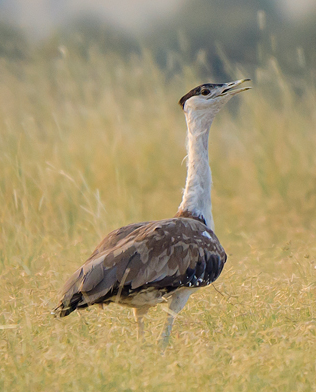 timated to survive as of 2018, reduced from an estimated 250 individuals in 2011. It is critically endangered on the IUCN Red List since 2011 (Bird Life International, 2018). It is protected under the Indian Wild Life (Protection) Act, 1972.
The main threats are hunting and habitat loss. In some places, such as Rajasthan, increased irrigation by the Indira Gandhi canal has led to increased agriculture and the altered habitat has led to the disappearance of the species from these regions (Raman, and Madhusudan, 2015). New threats to the species include the development of roads and electric power transmission lines in the desert that lead to collision-related mortality. Expansion of renewable energy infrastructure including deployment of solar panels over large areas of desert and grasslands is another threat to the bird's habitat.
Editor: Dr. Pradip Nandi Published by: National Centre for Human Settlements and Environment (NCHSE), E-5/A, Girish Kunj, Arera Colony, Bhopal - 462016 (M.P.) Email: nchsebpl@gmail.com, Website: www.nchse.org |
Copyright © 2025 NCHSE. All rights reserved.
Disclaimer: The information provided on this Newsletter is for general informational purposes only. NCHSE assumes no responsibility for errors or omissions in the content or for any actions taken based on the information provided. |